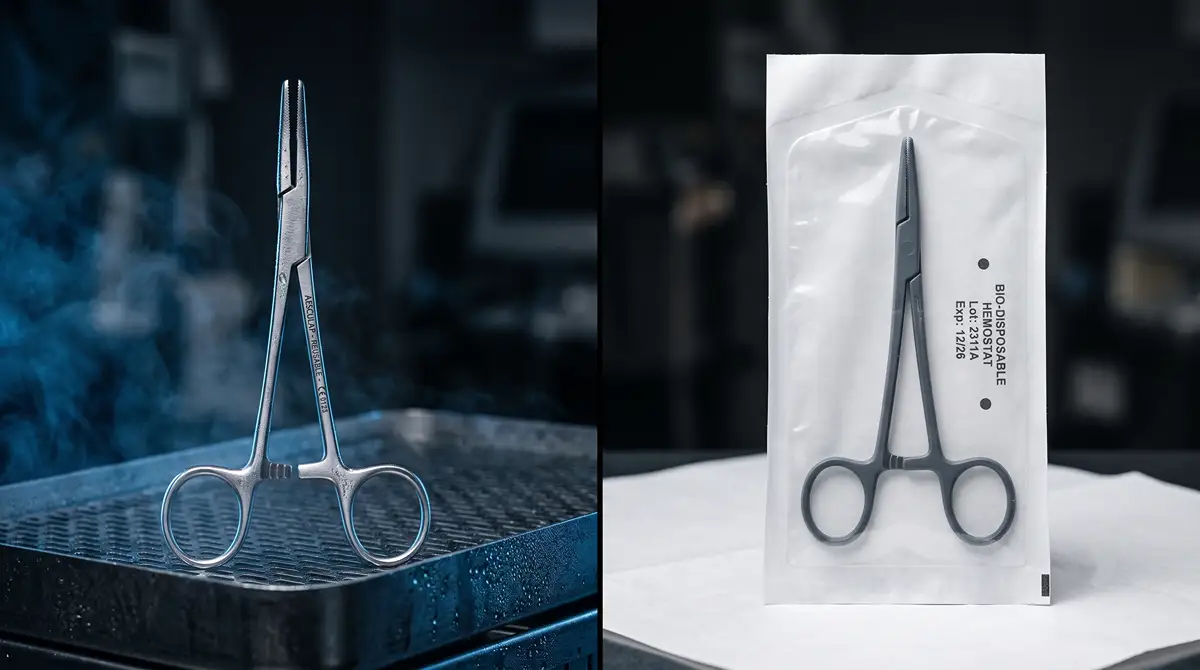
The choice between reusable and disposable surgical and dental instruments is one of the most consequential recurring decisions in healthcare procurement — and one of the least rigorously analysed. Most procurement teams inherit a model from their predecessor or adopt whichever option their current supplier makes easiest to order, treating a strategic decision as a settled administrative default. Both approaches carry a predictable cost: sustained overspend on disposable surgical and dental instruments in high-volume settings, or unaccounted sterilization infrastructure costs that make a reusable programme far more expensive than its unit price suggests.
Why This Question Has No Universal Answer — and Why That Matters for Your Procurement Strategy
The wholesale surgical and dental instrument procurement decision between reusable and disposable instruments changes materially depending on three facility variables: annual procedure volume, existing central sterile services department infrastructure, and the specific instrument categories under evaluation. A hospital performing 15,000 general surgical procedures annually with validated CSSD infrastructure reaches a completely different cost conclusion than a dental clinic with 200 monthly patient visits and no sterilization capability. Procurement teams that apply one model across their entire surgical and dental instrument category portfolio consistently mis-price their true instrument lifecycle cost.
The most common analytical error is evaluating unit price without total cost of ownership. A disposable surgical and dental instrument set priced at 12perprocedureappearsmoreeconomicalthanapremiumreusablesetat800 — until the reusable instrument is run through 500 sterilization cycles at a validated per-cycle processing cost of 1.80,reducingtheper−procedureinstrumentcostto3.40 and generating $4.30 per procedure in sustained savings against the disposable equivalent. The unit price comparison and the lifecycle cost comparison produce completely different procurement decisions from the same data.
Destination regulatory market adds a third variable that many procurement teams underestimate. EU markets carry specific traceability documentation requirements for reusable surgical and dental instruments that do not apply to single-use devices, adding compliance management overhead to the reusable programme that must be factored into the total cost of ownership analysis. A procurement model that is correctly optimised for one regulatory context may not be the correct model when the same instruments cross into a different market.
The Case for Reusable Surgical and Dental Instruments — What the Economics Actually Show
Total Cost of Ownership — The Sterilization Cycle Calculation
A premium reusable surgical and dental instrument — AISI 316L stainless steel, rated for 500+ validated sterilization cycles at 134°C — purchased at an average unit cost of 18–45 depending on instrument complexity amortises that purchase cost to a per-cycle instrument cost of 0.04–0.09. Against a disposable equivalent in the 3–12 per-use range, the reusable instrument reaches cost break-even at 3–10 procedure cycles and generates compounding per-procedure savings for every subsequent use across its 500-cycle lifecycle. For a hospital running 5,000 annual procedures with a 40-instrument set valued at 1,200,thetotalcostofownershipovertheratedlifecyclefallstoapproximately2.40 per procedure cycle — against 60–480 in equivalent disposable surgical and dental instrument spend at the same volume.
Instrument Performance Consistency and Clinical Reliability
Premium reusable surgical and dental instruments maintain dimensional accuracy, edge retention, and surface finish integrity across their rated sterilization lifecycle when correctly processed — performance characteristics that single-use instruments at equivalent or lower manufacturing specification cannot sustain for complex procedures requiring precise instrument geometry. Orthopedic surgical instruments, dental restoration instruments, and microsurgical sets are the categories where this performance differential is most clinically significant: joint precision, instrument flex tolerance, and cutting edge consistency all affect procedure outcomes at the margins where single-use instrument specification typically falls short. For procurement officers evaluating wholesale orthopedic surgical instrument categories, the performance lifecycle of the instrument — not the per-unit price — is the correct primary evaluation criterion when procedure complexity is the governing clinical variable.
Supply Chain Resilience — The Stocking Advantage
A reusable surgical and dental instrument inventory — properly maintained across its rated 500-cycle lifecycle — provides procurement teams with a strategic asset that does not require continuous replenishment on the 4–6 week restocking cycle that disposable programmes demand. During the 2020–2022 global supply chain disruption period, hospital networks operating predominantly reusable surgical and dental instrument programmes maintained clinical capacity at materially higher rates than facilities dependent on continuous disposable instrument restocking from disrupted international freight networks. For procurement directors managing supply chain resilience as a board-level risk, a reusable surgical and dental instrument programme covering high-volume procedure categories is a strategic buffer against supply chain disruption — not only a lifecycle cost optimisation exercise.
The Case for Disposable Surgical and Dental Instruments — Where They Win on Economics and Operations
Sterilization Infrastructure — The Hidden Cost of Reusable Programs
Running a CSSD capable of processing reusable surgical and dental instruments at hospital scale requires a capital and operational investment that procurement cost comparisons routinely exclude: autoclave equipment at 80,000–300,000 per validated unit, annual maintenance contracts averaging 15,000–40,000 per machine, CSSD facility space allocation, trained sterilization technician staffing at 2–4 FTE for a mid-size hospital, and sterilization validation auditing under destination market regulatory requirements. For a mid-size district hospital performing 3,000–8,000 procedures annually without existing CSSD infrastructure, building the sterilization capability required for a reusable surgical and dental instrument programme adds 150,000–500,000 in capital expenditure before the first reusable instrument generates a per-procedure cost saving. At procedure volumes below 2,000 per category annually, that infrastructure cost rarely amortises to a net saving within a realistic budget cycle — making a well-managed disposable surgical and dental instrument programme the correct economic default.
Infection Control — Where Disposables Eliminate Risk
No CSSD sterilization process — however well-validated — reduces the probability of sterilization failure to absolute zero: residual prion protein contamination, biofilm formation within instrument joints, and sterilization cycle documentation errors each contribute a non-zero infection transmission risk that accumulates across a reusable instrument’s lifecycle. In high-infection-risk clinical settings — spinal surgery with CJD transmission exposure, procedures on immunocompromised patients, and maxillofacial procedures with high bioburden — the case for disposable surgical and dental instruments is not primarily economic but a clinical risk management determination that infection control protocols increasingly mandate regardless of cost differential. For ENT surgical instruments in outpatient settings, and for dental hygiene instruments wholesale programmes supplying practices without validated CSSD infrastructure, single-use instruments eliminate a sterilization compliance obligation the clinical environment cannot fulfil to the standard the risk category requires.
Procurement Simplicity — The Operational Advantage at Scale
For healthcare facilities with limited procurement infrastructure — community hospitals, standalone dental clinics, and regional medical centres with single-person purchasing functions — disposable surgical and dental instruments eliminate four operational complexities simultaneously: CSSD scheduling coordination, instrument tracking across procedure sets, sterilization validation auditing, and instrument fatigue monitoring across lifecycle cycles. The procurement team manages a restocking programme against a confirmed consumption rate rather than a sterilization management system against a lifecycle calendar — a materially simpler operational model when procurement bandwidth is the binding constraint. For a surgical instruments distributor supplying a network of smaller dental and surgical facilities, a managed disposable surgical and dental instrument supply programme also simplifies downstream logistics: no instrument return tracking, no used-item inspection, and a predictable reorder cycle supporting consolidated bulk ordering.
The Compliance Dimension — What Your Destination Market Requires
ISO 13485 certification applies to both reusable and disposable surgical and dental instrument supply chains, but its practical implications differ between the two models. For reusable surgical and dental instruments, ISO 13485 governs the production quality management system that determines whether an instrument meets its rated sterilization cycle specification — sourcing reusable instruments from an ISO 13485-certified export partner provides independent audit evidence that instruments will perform to their lifecycle specification under validated sterilization protocols. For disposable surgical and dental instruments, ISO 13485 governs production quality and packaging integrity, confirming that the sterile barrier will maintain instrument sterility from point of manufacture through to point of use.
CE Mark compliance requirements differ materially between reusable and disposable surgical and dental instruments in EU markets: reusable instruments require lifecycle documentation — technical files covering material specification, sterilization validation data, and reprocessing instructions — that disposable instruments are not required to provide to the same regulatory depth. FDA registration requirements in US markets create parallel differences: single-use disposable surgical and dental instruments require specific labeling prohibiting reprocessing, while reusable instruments require reprocessing validation evidence as part of their regulatory submission. Both reusable and disposable surgical and dental instrument shipments entering regulated markets should be accompanied by a certificate of conformity, destination-appropriate compliance declaration, certificate of origin, and a product-level packing list — but the content of that compliance pack differs materially depending on which instrument category is in the consignment.
For procurement officers sourcing surgical and dental instruments across multiple regulatory markets simultaneously, the compliance documentation management is most efficiently handled by a single export operations partner who issues destination-specific documentation packs as a standard programme deliverable. This is particularly relevant for hospital buying groups managing multi-site procurement across EU and GCC markets concurrently, where the same instrument specification may require substantially different compliance documentation in each destination without the procurement team needing to manage the regulatory mapping independently.
The Hybrid Procurement Model — How Leading Hospital Networks Are Solving This Decision
The most analytically rigorous procurement approach — increasingly adopted by leading hospital networks in UK NHS supply frameworks, GCC health systems, and Southeast Asian hospital groups — is a hybrid surgical and dental instrument procurement strategy that assigns the correct instrument type to each procedure category based on the governing economic and clinical variables rather than applying a single model across the full instrument catalogue. General surgical instrument sets, orthopedic procedure instruments, dental restoration instruments, and complex microsurgical tools default to reusable at facilities with validated CSSD infrastructure — where the total cost of ownership calculation over 500 sterilization cycles strongly favours reusable economics over equivalent disposable spend at the same procedure volume. High-infection-risk procedure instruments, outpatient-setting single-use tools, and dental instruments wholesale categories for practices without validated sterilization capability default to disposable — where infection control requirements or the absence of CSSD infrastructure make reusable programmes operationally impractical regardless of the per-cycle cost advantage.
The category assignment across a hybrid programme should be reviewed annually against procedure volume data, since the break-even point between reusable and disposable surgical and dental instruments shifts as procedure volumes change. For ENT surgical instruments wholesale programmes specifically, the hybrid model frequently designates inpatient ENT surgical instrument sets for reusable programmes while outpatient ENT procedure instruments — single-use guides, disposable suction tips, single procedure scalers — remain disposable based on sterilization validation cost relative to outpatient procedure volume. Wholesale distributors supplying healthcare facility networks can apply this hybrid framework to advise their customers on instrument category strategy and position their catalogue as a managed combination of premium reusable surgical and dental instruments alongside a coordinated disposable surgical and dental instrument replenishment programme.
Consolidating both reusable and disposable surgical and dental instrument procurement through a single export operations partner creates compliance documentation and freight efficiency that fragmented sourcing across multiple suppliers cannot replicate. A single purchase order covering both instrument categories — with destination-specific compliance documentation issued as one consolidated pack and freight coordinated into one shipment — reduces per-unit freight cost, eliminates duplicate vendor qualification overhead, and gives the procurement team one accountable contact for the full surgical and dental instrument supply chain across both instrument types.
A Decision Framework — Five Questions That Determine the Right Model for Your Facility
Answer these five questions about your facility before committing to a reusable, disposable, or hybrid surgical and dental instrument procurement strategy:
- What is your facility’s annual procedure volume for each instrument category you are evaluating?
If your facility performs more than 2,000 procedures annually in a given instrument category with validated CSSD infrastructure, reusable surgical and dental instruments will reach cost parity with disposable equivalents within 10–15 procedure cycles and generate compounding per-procedure savings across the remaining lifecycle. Below 2,000 procedures annually per category, the total cost of ownership calculation is materially closer, and the infrastructure cost of a reusable programme may not amortise to a net saving within a realistic budget cycle.
- Does your facility have validated CSSD infrastructure — autoclaves, trained sterilization technicians, and validation protocols — in place or within your current capital budget?
Without validated sterilization infrastructure, a reusable surgical and dental instrument programme carries a hidden capital requirement of 150,000–500,000 for a mid-size facility before the first per-procedure saving is realised. If that infrastructure investment is not funded within the current capital programme, a well-managed disposable surgical and dental instrument programme is the correct default until the infrastructure case is separately established.
- Which instrument categories in your current clinical protocols carry a high infection control risk designation that your infection control team has flagged for single-use requirements?
Procedure categories with high infection control risk designation should default to disposable surgical and dental instruments regardless of the cost differential — the sterilization failure risk in those categories represents a clinical liability that outweighs the lifecycle economic argument for reusable instruments at any procedure volume. For all other categories, infection control risk should be assessed as one variable in the total cost of ownership model rather than as a blanket justification for a disposable programme across the full catalogue.
- What is your facility’s budget structure for this category — capital expenditure versus operational procurement spend?
Reusable surgical and dental instrument programmes require capital investment but reduce operational spend over time as per-procedure cost falls below disposable equivalents across the instrument lifecycle. If your facility’s budget structure does not accommodate capital expenditure for instrument purchasing in the current cycle, a disposable programme funded entirely through operational procurement spend may be the financially accessible model — even where the 5-year total cost of ownership analysis favours reusable.
- What is your supply chain resilience requirement for uninterrupted instrument availability during freight disruptions or extended supplier lead time fluctuations?
Reusable surgical and dental instrument inventories provide a strategic buffer against supply disruption that disposable programmes — dependent on continuous international replenishment — cannot replicate at comparable cost. If uninterrupted clinical capacity during supply chain disruption is a regulatory or board-level requirement for your facility, building a reusable surgical and dental instrument inventory across high-volume procedure categories is a risk management investment that belongs in the total cost of ownership calculation, not outside it.
How Bio Tech Globals Supports Both Reusable and Disposable Surgical and Dental Instrument Procurement
Bio Tech Globals coordinates the bulk export of premium reusable surgical and dental instruments across 50+ destination markets, with 200+ active SKUs spanning general surgery, orthopedic, dental, cardiovascular, ENT, and gynecology instrument categories available within a single consolidated export operation. Compliance documentation for each destination market — covering both reusable and disposable surgical and dental instrument regulatory requirements for US, EU, and GCC markets — is issued as a standard programme deliverable with every shipment, without the procurement team needing to specify which documentation set applies to each instrument type. The 98% on-time delivery rate across active export market relationships reflects the freight management and customs clearance infrastructure supporting multi-category, multi-destination surgical and dental instrument procurement programmes.
For procurement teams and wholesale surgical supply distributors building hybrid instrument procurement strategies, both reusable and disposable surgical and dental instruments are available on a single consolidated purchase order — one compliance documentation pack per destination market and one freight booking covering the full consignment. For distributors requiring wholesale orthopedic surgical instruments quotes across reusable and disposable categories, or dental instruments wholesale programmes covering both reusable restoration instruments and disposable hygiene instrument lines, itemised consolidated quotations covering all categories are returned within 48 hours of a complete instrument brief.
As a disposable surgical instruments exporter operating within the same consolidated programme as its reusable instrument supply, Bio Tech Globals’ export model allows procurement teams to manage both instrument types through one vendor relationship — eliminating duplicate qualification overhead, simplifying compliance documentation management, and consolidating freight across reusable and disposable surgical and dental instrument categories in a single export consignment. Every programme is managed by a named account coordinator with direct accountability from brief submission through to customs-cleared delivery. Minimum order quantities for reusable programmes start from 500 units per product line, with 4–6 week lead times from confirmed purchase order for catalogue instruments across both instrument types.
If you are evaluating or restructuring your surgical and dental instrument procurement strategy — whether reusable, disposable, or a hybrid model across procedure categories — sharing your instrument list, facility type, procedure volumes, and destination markets with the Bio Tech Globals export team produces a consolidated sourcing quotation covering both your reusable and disposable surgical and dental instrument requirements within 48 hours.
→ Request a Consolidated Instrument Sourcing Quote — Reusable and Disposable in One Shipment